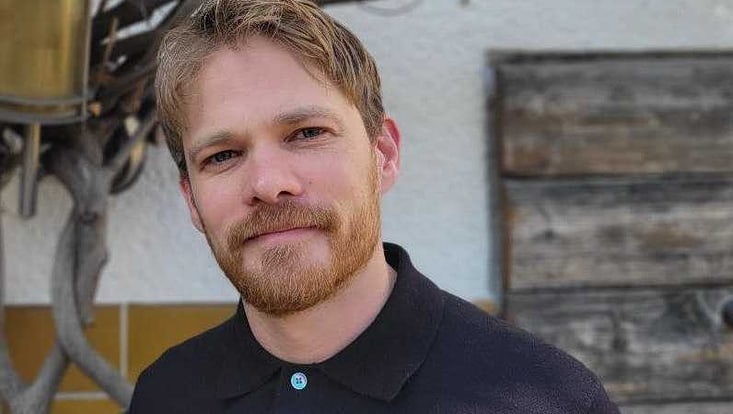
Werner Boschmann, M.A.

Curriculum
Werner Boschmann studied comparative literature and philosophy at the universities of Berlin and Zurich. He completed his M.A. with a thesis on the poetics of knowledge in Alexander Bogdanov's universal science "Tektology". He has been a research associate at the Institute for East European Studies at the Free University of Berlin since November 2022. His PhD project "Organisation and Transfer: Configurations of Energetic Bodies in Soviet Avant-Gardes" examines how concepts of energy circulating between science and art contributed to new models of the body in different discourses and practices. He is a member of the PhD programme "Epistemologies of Aesthetic Practices", a cooperation of the universities of Zurich.
Research project: Organization and Transfer: Configurations of Energetic Bodies in the Soviet Avant-Gardes
My dissertation examines the reciprocal relationship between energy and body discourses in the early Soviet Union. The point of departure is the epistemic shift from a mechanistic to an energetic worldview and conception of the human subject. This development transformed understandings of labor and material, artistic expressions, and notably, bodies and their environments. My guiding thesis posits that these diverse configurations of energetic bodies facilitated new intersections of knowledge forms, material and aesthetic practices, as well as utopian projections of the avant-garde movements. Through case studies positioned at the interstices of psychology, labor science, painting, and theater, this dissertation aims to contribute to a comprehensive understanding of the epistemic transformations that emerged amidst the increasing significance of energy and force concepts in the early twentieth century.
Research results: Organization and Transfer: Configurations of Energetic Bodies in the Soviet Avant-Gardes
The fellowship allowed me to focus intensively on a key case study of my dissertation analyzing the research practices of artist Boris Ender. Utilizing a handwritten experimental protocol from the Chardzhiev Archive this chapter reconstructs Ender's experiments in “seeing with a blindfold,“ conducted alongside the dance group Geptachor in Želézo, near St. Petersburg in late summer 1924. By suppressing retinal activity, Ender aimed to activate a cortical, tactile form of vision—seeing “with the back of the head“—to foster a holistic perception of the self and the environment.
Ender’s experimental design synthesized traditions of sensory physiology with an energetic biocentrism. Framing sight as a bidirectional exchange (obmen) between human and environment, his work intersects with a history of science centered on energy dynamics. His affiliation with the Department of Organic Culture (AOK) at the State Institute of Artistic Culture (GINChUK) further embeds these experiments in broader avant-garde investigations of color and form.
Ultimately, these fragmentary protocols highlight a core media-theoretical challenge: how to document intense bodily states. The chapter tackles this through two contrasting lenses: a hermeneutic reading that interprets Ender's protocols as a scientific secularization of mystical experience (ékstasis, myein), and a mediatheoretical reading that analyzes the handwritten text as a material inscription within a Kittlerian notation system (Aufschreibesystem).
To ground this research within the broader history of knowledge, I co-organized the May 2025 Hamburg workshop, “Bodies in Motion – Hidden Knowledge: Energies and Ecologies of Corporeal Practices around 1900,“ in collaboration with DFG and SNF research projects. This event generated vital cross-connections that have directly advanced the dissertation.